Part 4 · 4.5 Worked Reference Implementation
The walked example: one press release, start to finish
The nine moves of 4.1, with every number real, drawn from session loop-sem-1 (semantic class, Gemini 2.5 Flash) — reproduced tuple-by-tuple, gesture-by-gesture, in the companion technical reference. This file is the index into that fuller account, not a repeat of it.
§The object
"Acme Corp. today announced record quarterly revenue of $120M, up 40% year on year, and said it plans to open two new plants in 2027; the CEO called it a turning point."
§The nine moves, with their real offsets
| move | what happened | offsets |
|---|---|---|
| 1–2. the door | the text above committed; the world chose the press-release study, reason stated in full | #0–#16 |
| 3. four questions | which facts / where the areas / which relations / what form — typed one at a time, across the session | #18, #66, #117, #171 |
| 4. delegate ×4 | a press reader Cell opened for each — cell@37, cell@87, cell@140, cell@196, each with its own charter | #19–48, 67–98, 118–151, 172–207 |
| 5. ask ×4 | each Cell's reader answered with tagged findings and a summary | #52, #102, #155, #211 |
| 6. attest ×4 | Attest · accept on each — every Cell sealed, every export released | #58, #109, #163, #220 |
| 7. return + release ×4 | each finding carried back into its own vector's slot, released as a ledger entry | #65, #116, #170, #227 |
| 8. synthesise | the fourth attestation completed the report bind's barrier; it asked the world and the report was written, unprompted, in the same settle | #228 → #229 |
| 9. arrange the document | the four ledger entries and the report pinned to the sheet, in order; the four Cell rows — the workings — removed, leaving only the results | #230–238 |
Every one of these thirty-odd offsets, its full JSON payload, and the exact function that produced it is walked individually in the companion technical reference: start at its home page, or jump straight to one Cell opening, one reading, or the fourth attestation and the report firing.
§What the document looked like at the end
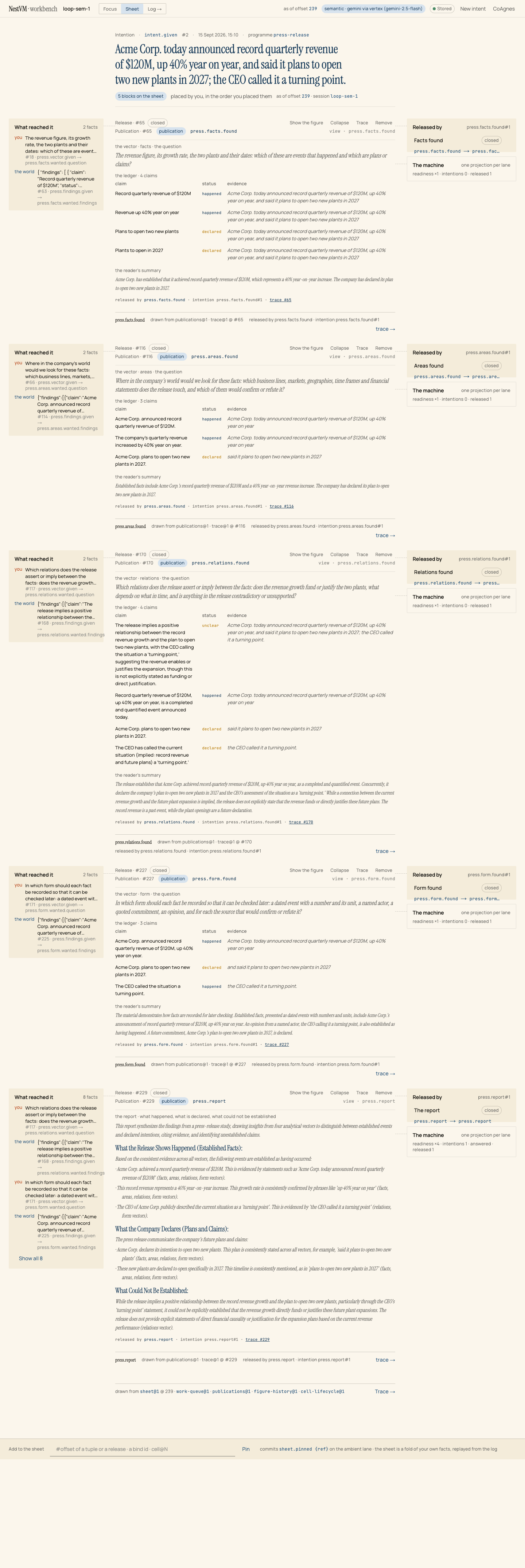
The intention stands as the head. Below it, four blocks — each a released ledger entry: the vector's own question, a table of claims with their status and their quoted evidence, and the reader's own summary. Last, the report, in its own three parts: what the release shows happened, what the company declares, and what could not be established — the barrier of move 8, made visible as an actual page.
§Reading it as an analyst, honestly
The revenue figure and its growth were tagged happened; the two plants, declared — correct, by the reader's own brief. Two things a careful reader should still catch, because the extraction step has no way to catch them on its own: the CEO calling it "a turning point" was folded into declared where a stricter reading would separate out a third category, opinion, since it is neither a plan nor an event; and happened, throughout, means the release reports it happened — a company's own announcement of its revenue is not, by itself, an independently audited fact, and nothing in the reader's tagging distinguishes "the company says so" from "this was independently confirmed." Neither of these is a failure of the mechanism described in this book — they are exactly the kind of judgement 4.1's move 6 exists to catch, and exactly why that move stays a person's, never the machine's.